vSAN Global Deduplication in VCF: More Capacity from the Same Hosts
My latest X thread covered vSAN Global Deduplication in VMware Cloud Foundation (VCF). A thread doesn't leave much room, so here is the longer version: what the feature is, how it works under the hood, what it requires, how it plays with encryption, and how to judge the savings without fooling yourself.
What Global Deduplication is
Storage is often a big piece of an infrastructure refresh budget. Deduplication cuts that down by finding blocks of data that are identical, keeping one copy, and replacing the duplicates with small metadata pointers. The freed space shows up as usable capacity.
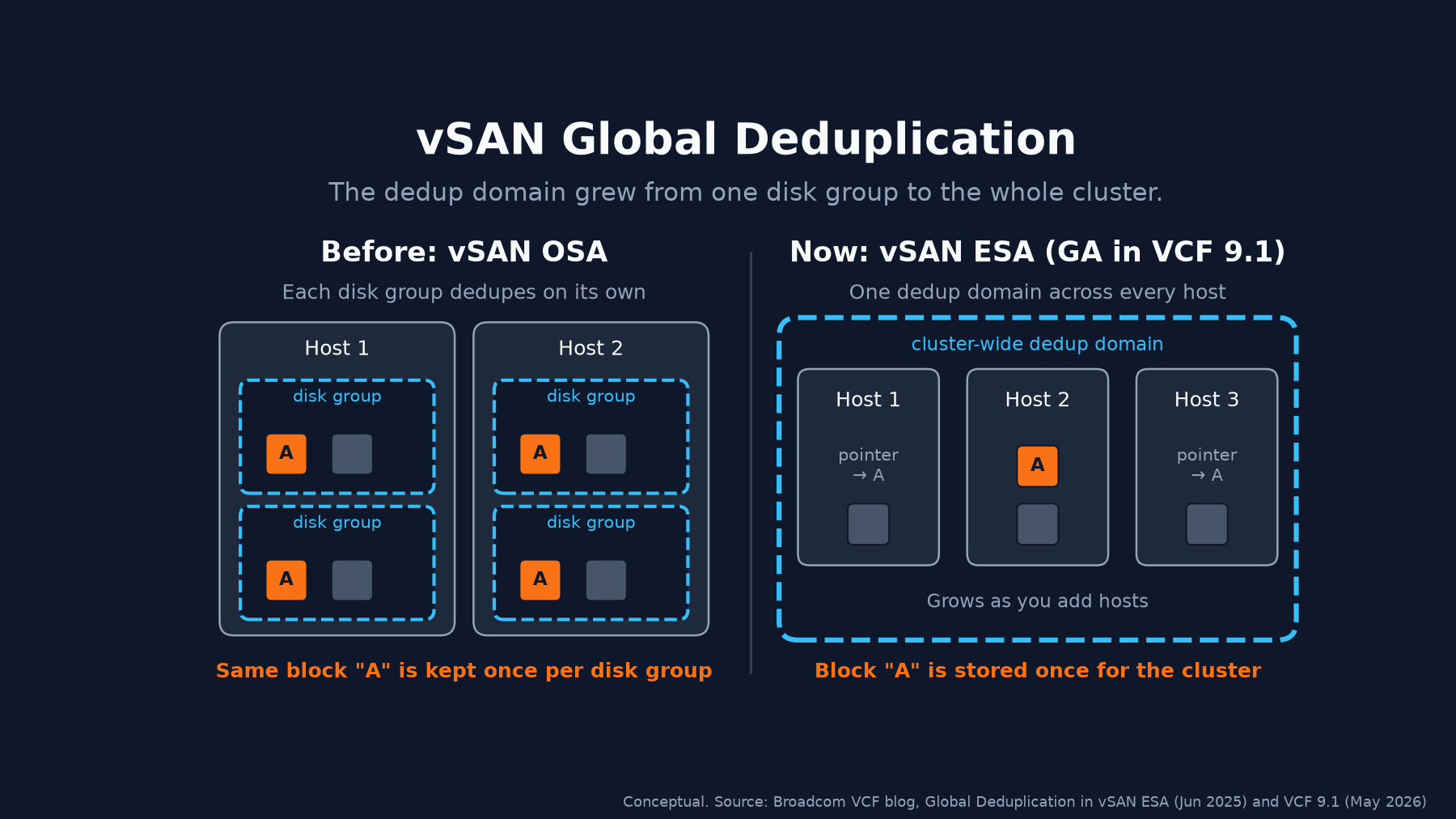
vSAN has had deduplication for a long time, but the original architecture (OSA) had a real limit: its dedup domain was a single disk group in a single host. If the same block lived on two disk groups, it was stored twice.
Global Deduplication in the vSAN Express Storage Architecture (ESA) changes the domain to the entire cluster. Any identical 4KB block anywhere in the cluster can be deduplicated, and the domain grows automatically as you add hosts. Broadcom's example: if an 8-host cluster grows to 16 hosts, capacity doubles but it's still one dedup domain.
Two things the bigger domain does not change:
- The failure boundary. Per Broadcom's design blog, a discrete storage device failure still only affects that device. The dedup domain grows; the boundary of failure doesn't.
- Compared with arrays. A traditional array's dedup domain is usually the array. Add a second array and the domain splits in two. A growing vSAN cluster stays one domain.
Availability: limited in 9.0, GA in 9.1
- VCF 9.0 (P01): limited availability through Broadcom's Technical Qualification Request (TQR) program. It was aimed at single-site vSAN HCI or vSAN storage clusters of 3-16 hosts on 25GbE or faster networking, and didn't support stretched clusters or Data-at-Rest Encryption.
- VCF 9.1 (GA May 12, 2026): generally available to all customers, with most of the 9.0 restrictions relaxed and Data-at-Rest Encryption now supported.
Broadcom doesn't label it a tech preview in either release, so I won't either.
How it works
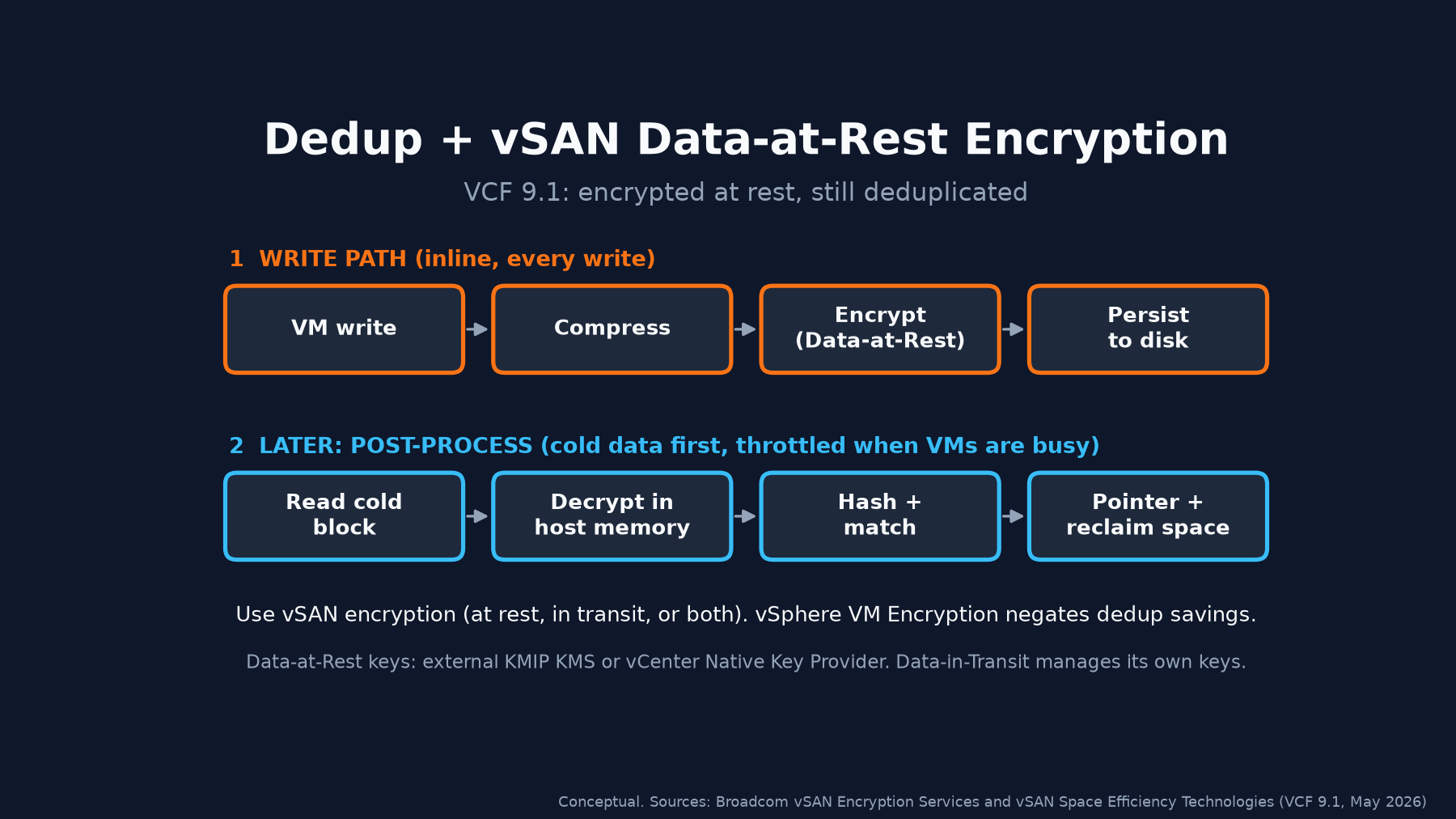
The big design choice is that ESA dedup is post-process, not inline. The write path is the same whether dedup is on or off: the VM writes, vSAN compresses the data high in the stack, encrypts it if Data-at-Rest Encryption is on, and persists it. Dedup happens later, against data that has "cooled down."
That matters for two reasons. First, dedup work stays out of the hot write path, so VM write latency isn't paying for it. Second, it doesn't waste effort on freshly written data that's often overwritten or deleted soon after.
When you turn it on, vSAN creates one or more special objects that are largely invisible to you:
- Dedup metadata object: holds a hash entry for every 4KB block.
- Dedup data object: holds the blocks that have been deduplicated. Broadcom moves them into dedicated objects to avoid I/O hot spots on any one VM.
Then, roughly in this order, vSAN:
- Reads a 4KB block (colder data first) and generates a cryptographic hash. In 9.1, that work is offloaded lower in the stack, and if the data is encrypted, the block is decrypted in memory first.
- Looks for a matching hash in the metadata object.
- If a match already lives in the dedup data object, it replaces the block with a pointer and reclaims the space.
- If a match exists but isn't in the dedup data object yet, it moves the data there (using a back-pointer to find the original), points both blocks at it, and reclaims the space.
- If there's no match, it leaves the data alone and records the hash with a back-pointer, so a future duplicate can be caught.
A few operational details worth knowing:
- It throttles itself. vSAN treats dedup data movement like resync traffic, so adaptive resync and network traffic shaping keep VM I/O first. It does more work during quiet periods and less when the cluster is busy. Broadcom says there's no tuning for you to do.
- Scaling is automatic. Deduplicated data is sharded across hosts, so adding hosts adds dedup processing capacity too.
- Turning it on doesn't force a reformat. Unlike OSA, enabling it doesn't trigger rolling reformats or big data movement.
- Turning it off only pauses it. New writes stop being deduplicated, but data that's already deduplicated stays that way.
- Be patient. Broadcom says it may take a few days for the system to learn, do the work, and show results in the UI.
- 9.1 also changed compression. ESA compression in 9.1 moves from LZ4 to a tuned ZSTD algorithm and is now always on at the cluster level. Existing data keeps the old compression until it's rewritten, so upgraded clusters see the gain over time.
Requirements and limits (VCF 9.1)
- vSAN ESA only. OSA keeps its older per-disk-group dedup.
- Single-site vSAN HCI clusters or vSAN storage clusters, 3 to 64 hosts.
- No stretched clusters or 2-node clusters. And once dedup is on, you can't convert that standard cluster into a stretched cluster. Decide on topology first.
- Thick-provisioned VMs aren't deduplicated. Switch a VM to thick and vSAN stops deduplicating it; switch back to thin and it resumes.
- HFTT-3 policies aren't deduplicated. Move a VM's policy to HFTT-3 and vSAN stops deduplicating it and marks it non-compliant. It resumes at HFTT-2 or lower.
- It overrides per-VM space efficiency settings. Once it's enabled, dedup applies to almost all VMs (except thick and HFTT-3), even if the VM storage policy has its own data reduction setting.
- Rack layout matters. Broadcom's space efficiency paper suggests that keeping a dedup cluster within a single rack can be preferable, since it typically depends on one pair of top-of-rack switches. If a dedup cluster spans racks, make sure your spine and leaf design can survive switch failures.
Turning it on is a single toggle: in the vSphere Client, select the cluster, go to Configure > vSAN > Services, edit Data Reduction and Encryption, enable deduplication, and apply.
Encryption and security
This is where 9.1 got interesting for anyone in a security-conscious or regulated environment. Encryption and dedup usually fight each other. Encrypted blocks look random, so identical plaintext doesn't produce identical stored blocks, and dedup ratios collapse. In 9.1, Broadcom says vSAN ESA dedup works with vSAN Data-at-Rest Encryption without reducing dedup ratios.
How dedup handles encrypted data
- Data is encrypted on write. In 9.1, Data-at-Rest Encryption starts at the DOM owner rather than the DOM client, which Broadcom says better separates encryption duties in HCI and disaggregated storage clusters and sets up efficient dedup post-processing.
- Dedup decrypts in memory, later. When post-processing scans a block, it decrypts it in host memory, hashes it, and compares it against other potential duplicates. That's how it can dedupe encrypted data without losing efficiency.
- Encryption happens after compression. That means less data to encrypt.
- The cipher. Per the 9.1 docs, ESX encrypts disk data with AES-256 in XTS mode. In ESA, all disks in the cluster share one Data Encryption Key (DEK) for object data, which is wrapped by a Key Encryption Key (KEK) from the key provider. vSAN uses AES-NI CPU offload to keep overhead low.
Use vSAN encryption, not VM Encryption
This is the most important practical point in the whole post. Broadcom's guidance is blunt: if you need encryption, always use vSAN encryption services (Data-at-Rest, Data-in-Transit, or both) rather than vSphere VM Encryption. VM Encryption encrypts data before it reaches vSAN, which negates the dedup savings. Broadcom also says it lowers performance and adds complexity, and recommends against combining VM Encryption with vSAN encryption.
Key providers: Native Key Provider vs. external KMS
Data-at-Rest Encryption needs a key provider. You have two options:
- External KMS. Any KMIP 1.1-compatible key server. vCenter requests an AES-256 KEK from it and stores only the key ID, not the key itself. Hosts never write the KEK to disk unless they have a TPM.
- vSphere Native Key Provider (NKP). Built into vCenter, no external KMS required. vCenter generates the KEK and pushes it to the hosts, which generate the DEKs. NKP can coexist with existing key server infrastructure.
A few Broadcom recommendations worth following either way:
- Put a TPM in every host. Broadcom repeats this recommendation several times in its encryption paper. With TPMs, keys persist securely on each host, so hosts can reboot and unlock storage even if the key provider is unreachable. Without one, a rebooting host waits for the KEK before it mounts its storage devices, which can take several minutes or longer. With NKP, key persistence is on by default; with an external KMS, you enable it (
esxcli system settings encryption set --mode=TPM, thenesxcli system security keypersistence enable). - NKP with and without TPMs. Without TPMs, the NKP's Key Derivation Key is stored encrypted on the host's boot or configuration device and relies on the hypervisor to protect it. With TPMs, the TPM only releases the key after an integrity check, which Broadcom says is much more secure against physical theft.
- Back up your NKP keys. Broadcom says to always back up NKP keys to an external location, along with routine vCenter backups. This is the one I'd put on a checklist today.
- Watch where the KMS lives. Placing an external KMS on the same cluster it protects can create a chicken-and-egg problem on cold start if hosts don't have TPMs. NKP is more flexible here: running the vCenter that provides NKP on the cluster it encrypts is acceptable as long as every host has a TPM.
- Rekey options. A shallow rekey replaces the KEK; a deep rekey replaces the KEK and DEKs and is a rolling operation.
Encryption in transit
- Data-in-Transit Encryption encrypts vSAN traffic between hosts and manages its own keys automatically, so it needs no KMS or NKP. Hosts joining the cluster are authenticated with dynamically generated symmetric keys.
- New in 9.1 for disaggregated designs: Data-in-Transit Encryption also covers traffic between client clusters and vSAN storage clusters, which gives you end-to-end encryption for storage traffic.
- Is Data-at-Rest enough on the wire? Because ESA encrypts high in the stack, Data-at-Rest data is already encrypted when it crosses the network. Broadcom notes that may not satisfy strict requirements that every packet have a unique hash (a mirrored write, for example, may send identical ciphertext twice). If you're under those requirements, turn on Data-in-Transit too.
- Two patterns for vSAN storage clusters. Broadcom describes (1) Data-at-Rest plus Data-in-Transit on the storage cluster and Data-in-Transit on the client cluster, for unique per-packet encryption everywhere at some possible performance cost, or (2) Data-at-Rest on the storage cluster and Data-in-Transit only on the client cluster, which Broadcom says may be good enough unless you're under the strictest regulatory requirements.
How to judge the savings
Broadcom does not promise a dedup ratio, and neither will I. Savings depend on how alike your data is, what kind of data it is, and how much data is in the cluster. A few things to keep in mind:
- The best-known number is a lab best case. In an internal Broadcom test on VCF 9.0, 50 full clones on vSAN reached an overall data reduction ratio of 45.27:1 (dedup plus compression), compared with 41.3:1 on a competing array. Broadcom states plainly that this example "is not a representation of deduplication rates found in general data sets." Full clones are about the most dedup-friendly data there is. Don't plan capacity on it.
- Data type matters. Broadcom notes structured data such as OLTP databases may have less duplicate data than unstructured data. Already-compressed formats (images, video) won't compress further, and Broadcom recommends a conservative approach to estimating compression. Applications that encrypt their own data will also defeat dedup.
- Watch the overall Data Reduction Ratio. In 9.1, the new Effective Capacity view expresses savings as ratios: data reduction, thin provisioning savings, and snapshot savings. Expanding the data reduction ratio shows separate dedup and compression numbers. After you enable dedup, it's normal for the compression ratio to drop while the dedup ratio rises and the overall ratio improves. Broadcom recommends focusing on the overall Data Reduction Ratio, not the individual numbers.
- Use the vSAN Capacity view, not the Datastores view. Broadcom recommends against using the vSphere Client's Datastores view to judge vSAN capacity consumption.
- Ratios aren't standardized across vendors. Some vendors fold thin provisioning or clones into "data reduction," and some leave out metadata overhead. Compare like with like.
- Give it a few days. Because dedup is post-process, results take time to appear.
Turning a ratio into capacity
Broadcom's space efficiency paper gives a worked example. A 10-host single-site cluster with about 40TB per host has about 394TB raw. The Effective Capacity view, which accounts for resilience overhead, shows about 203TB. Apply a data reduction ratio and you get the effective usable capacity:
| Data reduction ratio | Approximate usable capacity | Versus raw capacity |
|---|---|---|
| 2:1 | ~400TB | About equal to raw |
| 4:1 | ~800TB | About 2x raw |
| 6:1 | ~1.2PB | About 3x raw |
| 8:1 | ~1.6PB | About 4x raw |
These are illustrations of the math, not predictions for your data.
The licensing angle
Broadcom's August 2025 blog points out that each VCF core license includes 1 TiB of raw vSAN capacity. Dedup doesn't change the entitlement, but it lets you store more data within it. Broadcom's own example: a 6-host cluster with 32 cores per host is entitled to 192 TiB, and if that cluster achieved 6:1, it could store nearly 1.2 PiB.
About the TCO numbers
You may see figures like "up to 34% lower TCO," "29% lower cost per TB," or "dedup alone can cut VCF cost by as much as 4%." Those come from the same Broadcom blog and are Broadcom's own model estimates: a 10,000-core environment with assumed CPU utilization and licensing costs, comparing VCF with vSAN against VCF with a competing array. The 34% and 29% figures are about vSAN overall (compression plus dedup versus an external array), not dedup alone; Broadcom puts dedup's own contribution in that model at up to about 4% of total VCF cost. They're vendor modeling, not measured customer savings, so treat them as a reason to run your own numbers, not as the answer.
How to get started
- Check fit. ESA, single site, 3-64 hosts, not stretched or 2-node, and no plan to stretch it later.
- Pick your encryption model first. If you need encryption, plan on vSAN Data-at-Rest (and Data-in-Transit if your requirements call for it), not VM Encryption. Choose NKP or an external KMIP KMS, put TPMs in the hosts, and back up NKP keys.
- Review policies. Find thick-provisioned VMs and HFTT-3 policies; they won't benefit.
- Turn it on under Configure > vSAN > Services > Data Reduction and Encryption.
- Wait, then measure. Give it a few days and track the overall Data Reduction Ratio in the Effective Capacity view.
If storage is what's driving your next hardware purchase, this is worth a look before you sign the PO.
Sources
- VCF 9.1 Release Notes, What's New: vSAN (Broadcom TechDocs)
- VMware Cloud Foundation 9.1 Release Notes (Broadcom TechDocs)
- Using Global Deduplication and Compression in vSAN ESA Cluster (Broadcom TechDocs, VCF 9.1)
- Enable Global Deduplication on an Existing vSAN ESA Cluster (Broadcom TechDocs, VCF 9.1)
- How vSAN Data-at-Rest Encryption Works with the KMS (Broadcom TechDocs, VCF 9.1)
- More Capacity with VMware vSAN Compression and Global Deduplication in VCF 9.1 (VCF blog, May 7, 2026)
- Global Deduplication in vSAN ESA for VMware Cloud Foundation 9.0 (VCF blog, June 19, 2025)
- Save Costs and Scale Efficiently with vSAN Deduplication in VMware Cloud Foundation 9.0 (VCF blog, August 20, 2025; source of the 45.27:1 lab result and the TCO model estimates)
- Greater Flexibility and Security with vSAN Storage Clusters in VCF 9.1 (VCF blog, May 12, 2026)
- vSAN Space Efficiency Technologies (Broadcom tech paper, VCF 9.1, May 11, 2026)
- vSAN Encryption Services (Broadcom tech paper, VCF 9.1, May 6, 2026)